Showing posts with label psychology. Show all posts

Theory of Knowledge for the IB Diploma Review

Theory of Knowledge for the IB Diploma
Average Reviews:

(More customer reviews)
This book presents the foundations of our knowledge. How do you "know" something? How do you judge authoritative sources? What is the basis of knowing? Is your grandmother's wisdom as valid as your MD mother's? If so, why? In the Information Age, it is often difficult to understand which bricks to use while building the foundations of our opinions and striving for true wisdom. The "Theory of Knowledge" provides some guidelines. An essential book for the required IB course with its name, it should be a required document for anyone who is preparing for higher education in the 21st century.

Click Here to see more reviews about: Theory of Knowledge for the IB Diploma

This comprehensive and accessible book is designed for use by students following the Theory of Knowledge course in the International Baccalaureate (IB) Diploma Programme. The book is also useful for students following other critical thinking courses. The fundamental question in Theory of Knowledge is How do you know? In exploring this question, the author encourages critical thinking across a range of subject areas and helps students to ask relevant questions, use language with care and precision, support ideas with evidence, argue coherently and make sound judgements.

Buy Now

Click here for more information about Theory of Knowledge for the IB Diploma

Read More...

Psychology Review

Psychology
Average Reviews:

(More customer reviews)
Psychology is no longer a discipline with a few sub-disciplines that need to be examined. Now there are branches of cognitive psychology that need to be discussed with more clarity, the growing ideation concealed beneath the umbrella term "positive psychology" that needs to be introduced sooner and with more zeal, and there are so many other themes that need to be looked out but just don't seem to be "important" to people trying to prime future students. When you look at the 8th edition of Myers Psychology you can see how all of this can be looked addressed by an instructor without overloading students in the process, and you can also see how the author(s) took the time to look deeper than the average creator of books. This doesn't cover the instructor resources, either, which are well worth the time and attention of anyone looking for newer researcher to discuss.
If you are a teacher looking at this, check out the resources and the DVD that comes in the mix because the video library they provide certainly is beyond the mundane norm.
The 8th edition is 18 chapters in length, covering: A Prologue on Psychology, 1 - Thinking Critically, 2 - NeuroScience and Behavior, 3 - Nature Nurture and Human Behavior, 4 - Development through the Lifespan, 5 - Sensation, 6 - Perception, 7 - States of Consciousness, 8 - Learning, 9 - Memory, 10 - Thinking and Language, 11 - Intelligence, 12 - Motivation and Work, 13 - Emotion, 14 - Stress and Health, 15 - Personality, 16 - Psychological Disorders, 17 - Therapy, 18 - Social Psychology, and an Appendix on Careers in Psychology.
In these I liked a few things, including:
(1)The fact that many of these ask a student to "think critically," not just presenting information but allowing the student to interject their opinion on the subject. I thought that was a rewarding thing to see because, above anything else, too many introductory classes leave the student out of the equation.
(2)The fact that some of the chapters treat new ground not covered by most introductory books and do so interestingly. This means that the book gives the students some interesting topics to look at and not just the background of Freud, Erickson, Maslow, and the other well-known names.
(3)The book discusses issues separately that should be separated. Therapy and Psychological Disorders is one of those, and Chapters 5 - 10 are others that also fall in that realm.
(4) The book looks into issues that are not normally covered without delving into some sort of Developmental Psychology, some Cognitive Psychology, Abnormal Psychology, and a few other classes. Basically, you have a lot of mini classes cocealed within this one book, allowing the instructor to design their own approach to teaching.
While this may not be the most favored book for students who want a continuum from their high school highs, it is a great book to introduce people to the disciplines of Psychology and allows for a lot of deviation by the teacher. I would certainly recommend it as a primer for Psychology majors, allowing them to see just what the field has to offer. Too often that isn't expressed, with careers in Counseling or Mental Health always taking precedent over Research careers or hose in the Industrial sector.
It really is nice to see something that showcases just how broad the world really is.


Click Here to see more reviews about: Psychology

David Myers's Psychology is a textbook like no other--always fresh, always introducing effective new tools for teaching and learning, and always attuned to the fascinating ways that new research can shape the introductory psychology course. The new Eighth Edition is vintage Myers. It redefines excellence for an introductory psychology textbook, raising the standard with its expanded emphasis on diversity and gender issues, its incorporation of new frontiers in research studies in such areas as neuroscience and cognition, new learning features, and its expanded media/supplements package.Myers continues the tradition of previous editions of bonding psychological science with a broad perspective that engages both the mind and the heart.

Buy Now

Click here for more information about Psychology

Read More...

Emotions Revealed: Recognizing Faces and Feelings to Improve Communication and Emotional Life Review

Emotions Revealed: Recognizing Faces and Feelings to Improve Communication and Emotional Life
Average Reviews:

(More customer reviews)
Everyone has an understanding of emotion, but few people agree on what the word really means. For example, how is 'emotion' differentiated from 'feeling'? Are emotion and logic independent? This book should help you explore these questions.
Ekman starts with arguments for the universality of emotional display. All humans produce the same facial displays when engaged in a moment of anger or sadness. Reactive displays are generally 'honest' but fleeting. All socially adept humans have learned to disguise their emotional displays. Sometimes a high-speed camera is required to capture and 'freeze' the initial 'true' display. Given the difficulty of 'real time' determination of an emotional display's meaning, Ekman standardizes his approach on a suitably literal plane. For example, the raise eyebrow means 'X' in 'Y' percent of the population, but only 'Z' percent recognize it.
Here is an outline of characteristics Ekman uses to define emotions:
1. Emotions are experienced as feelings, a set of sensations that we experience and often are aware of.
2. An emotional episode can be brief (less than a second to several seconds). If it is longer, it is a mood
3. It is about something that matters to the person
4. We experience them as happening to us, they are not chosen.
5. We are constantly scanning our environment. Emotional responses are automatic reactions to these perceptions. In this sense, emotions are an 'early warning system'.
6. Refractory periods exist after the emotional response. During this refractory period, only perceptions that supports the emotional response is considered.
7. The refractory period may last a few minutes or much longer
8. We generally become aware of an emotion only after our attention begins to review it in the past tense.
9. There are universal emotional themes. We become emotional about matters that were relevant to our ancestors as well as ones we have found to matter in our own lives.
10. The desire to experience or not experience an emotion motivates much of behavior.
11. An efficient signal, clear, rapid and universal, informs those that witness the display. The knowledge gained makes social cooperation possible.
All of this background information takes up the first 4 chapters. Many readers will find this an unnecessary delay. Much of this material seems to wander about in politically correct debates about 'why we can't all be nice', or 'can education ban anger?'.
Many will find this clueless and banal, but there is a lot of useful material mixed in. Take the time to suffer through it.
The curious hand ringing over the 'value' of anger is a testimony to stifling academic conformity on US colleges. Ekman is arguing there is a genetic componet to emotional IQ. The thesis is politically incorrect and sure to ruin a promising academic career. I decided the author had to demonstrate his touchy-feely sensitivity so the academic 'children are blank slates' mob wouldn't hang him.
Finally, on page 97, almost half way through the book, we get to the material most readers were looking for when they pulled the book off the shelf: reading emotional states from facial expression: The first lesson is on 'Sadness and agony.' The following chapter addresses 'Anger.' In all, Ekman describes 6 emotions:
1. Grief, sadness
2. Anger
3. Surprise
4. Contentment, Enjoyment, sensory pleasures:
5. Fear
6. Disgust, contempt
Ekman apologizes for avoiding any discussion of
1. Envy
2. Guilt, shame and embarrassment.
While exploring these emotions, Ekman uses the following format:
1. A general description of the emotion
2. A paragraph or two inviting the reader to 'make the face as a method of experiencing the emotion)
3. A longer section, with photos and discussion of muscular mechanics, suggesting ways to recognize the facial displays associated with the emotion.
4. A page or two on using the skill. This is always a description of an interaction with a boss. I didn't find these very useful.
There seems to be a fundamental distinction between sadness and anger, one drives out the other. Most people have heard of the 'fight/flight' dichotomy, but it turns out fight/flight emotions are very easily represented in the face simultaneously. Sadness-Anger is a more telling distinction. They don't coexist simultaneously. One's emotions can swing from sadness to anger, and back, sometimes fairly quickly, but they don't show up on the face at the same time.
The stark differences between the two, combined with the universality of expression, suggest expression and emotion are inextricably linked. The author suggests making the expression of anger and/or sadness because making the expression produced the experience of that emotion. Combine this with the fact that anger begets anger (both in the emotional individual and those that observe the sign) and sadness begets sadness and ultimately depression, and one can see that not only is the 'expression' the emotion, but the expression can drive the emotion. Additionally, we respond entirely differently to sadness and anger. When we see an expression of sadness, almost all are moved to comfort the sad individual. This feeling is so strong that just looking at a photograph of a sad individual, particularly a familiar individual, elicits strong experiences of sadness in oneself. When anger is expressed 'in the flesh', we may become enraged ourselves. On the other hand, a photograph of rage rarely elicits rage all by itself. For example, you can go to a tearjerker at the theatre and expect 50% of the crowd to be awash in tears. A still photo of rage almost never elicits rage. The viewer must know the individual's context in great detail to respond with rage. On the other hand, people can be talked into rage (see mob behavior) with relatively little difficulty.
Highly recommended.

Click Here to see more reviews about: Emotions Revealed: Recognizing Faces and Feelings to Improve Communication and Emotional Life


Buy Now

Click here for more information about Emotions Revealed: Recognizing Faces and Feelings to Improve Communication and Emotional Life

Read More...

Casework: A Psychosocial Therapy Review

Casework: A Psychosocial Therapy
Average Reviews:

(More customer reviews)
I have been teaching graduate social work for fifteen years and have yet to discover a text about psychosocial casework that surpasses this revised classic in its clarity, depth, thouroughness, and wisdom. The basic psychosocial orientation and typology of casework procedures defined by Florence Hollis remains intact, yet the text, as a whole, is substantially updated by Mary Woods, whose fluid prose is rich in clinical detail, articulate, and aimed at what the practitioner yearns to know and needs to know. As an experienced clinician, I still turn frequently to the chapters on couple and family treatment where protocols for navigating these exceptionally tricky modalities are clearly presented. In chapter 16, for example, Mary Woods develops a typology of "relationships and problems" detailing 12 patterns of couple conflict that, in itself, serves as a primer for the novice practitioner. Approaches to nontraditional couples (premarital couples, unmarried pairs, cross-cultural relationships, and gay and lesbian couples) are amply discussed as well with sensitive consideration of social differentials in power experienced by men and women and by couples of color. The text consistently partializes assessment and techniques of intervention so that one can read and assimilate complex clinical procedures in bite size pieces. Heuristics are laced throughout the text, giving one a feeling of personal guidance. The fifth edition of Casework is a treasure chest for students and teachers of social work and the helping professions to dig into time and time again.

Click Here to see more reviews about: Casework: A Psychosocial Therapy

Known in academic circles as the "bible" for clinical practitioners of social work, Casework: A Psychosocial Therapy introduces readers to the basic theory and principles in the practice of psychosocial therapy, along with attention to the historical development of the approach as it has been enriched and expanded over the years.The authors' approach reflects a balanced focus on people, their environment, and the ways in which people interact with their environment. Essential techniques including how to conduct initial interviews with clients, crisis intervention, arriving at assessments, and choosing appropriate treatment, are thoroughly explained, and often clarified with case studies and vignettes, preparing readers to assess social work clients from a variety of perspectives.The book is designed for the graduate-level student who needs to master the principles, theories, and approaches of the psychosocial approach to applied practice, but it may also be used to fit a variety of courses, including the Introduction to Social Work BSW student who is looking for supplemental information on the basics of clinical practice.Now in its fifth edition, Casework has been thoroughly revised to keep discussions clear and up to date.New material has been added throughout, including a greater variety of case studies, discussions about current topics such as the influence of ethnicity and diversity in the social work practice, changes in family life roles, changes in ideas and practice approaches, and a significantly updated bibliography for reference.

Buy Now

Click here for more information about Casework: A Psychosocial Therapy

Read More...

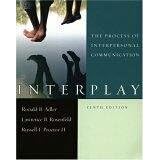
Interplay: The Process of Interpersonal Communication Review

Interplay: The Process of Interpersonal Communication
Average Reviews:

(More customer reviews)
This is an excellent text for an undergraduate course on interpersonal communication. In addition to easy-to-understand content, the end-of-chapter exercises are helpful (as are the ones that can be found in the instructor's text). An all-around good book.

Click Here to see more reviews about: Interplay: The Process of Interpersonal Communication

Now in a new edition, Interplay: The Process of Interpersonal Communication provides a comprehensive and engaging introduction to communication in interpersonal relationships. Based on an extensive body of scholarship, Interplay cites more than 1,200 sources--almost 25% of which are new to this edition--and provides a variety of thought-provoking photos, sidebars, and cartoons that illustrate key points in the text and connect them to everyday life and popular culture. Updated and revised throughout, the tenth edition is now more accessible and useful to students, with revisions based on detailed recommendations by leading scholars in the field. UPDATED FEATURES OF THE TENTH EDITION * Revised and expanded material examines the relationship between gender and language use, the pervasiveness and inevitability of casual "mindless" listening, conflict styles, co-cultures within American society, and relational maintenance. * Focus on Research sidebars--50% of which are new to this edition--summarize current research on interesting and important topics. New profiles provide information on such topics as cell phone etiquette, self-presentation strategies of first-generation college students, unwritten rules for expressing emotions on the job, methods used by college students to discourage drinking and driving, and the functions of telling secrets in close relationships. * Film Clips--50% of which are new to this edition--profile recent feature films that illustrate communication concepts. These clips include Crash (stereotyping), Garden State (emotional expression), 50 First Dates (relational stages), Bend It Like Beckham (relational dialectics), and Before Sunset (self-disclosure). * An inviting new design features provocative photos and clever cartoons that reinforce concepts from the text and encourage students to explore the book's content. * The Interplay website at www.oup.com/us/interplay offers a wealth of resources for both students and their professors--online self-testing and other study aids, links to a variety of communication-related websites, and "Now Playing" reviews of recent films.

Buy Now

Click here for more information about Interplay: The Process of Interpersonal Communication

Read More...

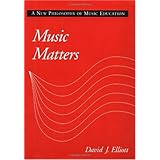
Music Matters: A New Philosophy of Music Education Review

Music Matters: A New Philosophy of Music Education
Average Reviews:

(More customer reviews)
I'm currently a PhD student in music education (and, also, a Band director). I've been required to read several books on the Foundations of Music Education for my course requirements. Compared to the others I've studied so far by Mark, Abeles, Reimer, and Swanwick, Music Matters is by far the most intelligent and comprehensive. It's more challenging to read than any of the others, but it's worth the effort.

Click Here to see more reviews about: Music Matters: A New Philosophy of Music Education

There is a mystery about music. On one hand, music making and music listening have occupied a prominent place in every culture since the dawn of recorded history and people everywhere continue to engage in a variety of musical experiences as part of their daily lives. Yet questions about the nature and value of music and its importance as a subject of education remain perplexing to many thinkers and are still hotly debated, even today. As a result, while music has been part of the school curriculum since antiquity, its profound contribution to general education has never been harnessed--until now.What is music? Does music deserve a place in general education? If so, why? Music Matters builds new answers to these basic questions through a wide-ranging examination of music as a diverse human practice. The result is a ground-breaking philosophy of music education that provides critically reasoned perspectives on the nature and significance of performing, listening, musicianship, multiculturalism, creativity, consciousness, curriculum development, and more. Indeed, Music Matters is exceptional for the attention it pays to many aspects of music and education that previous music education doctrine either misses or ignores altogether. Following an incisive critique of past thinking, this important text develops a multidimensional concept of music that explains why music making and listening are unique forms of thinking and unique sources of the most important kinds of knowing that human beings can gain. In a richly detailed narrative that examines a wealth of recent philosophical and psychological research, the author constructs a compelling philosophical foundation that allows teachers to affirm to themselves and others that music deserves a central place in the education of all people. Among the many working ideas of this new philosophy is a distinctive concept of "curriculum-as-practicum" that explains how music educators can fulfill their educational mandate.Invaluable as a core text for courses on foundations of music education or philosophy of music education at both the undergraduate and graduate level, Music Matters provides educators with critically reasoned perspectives on the "why, what, and how" of music teaching and learning, arguing convincingly that music is one of the most vital, dynamic, and practical pursuits in the human repertoire and, therefore, fundamental to the full development of the individual and collective self.

Buy Now

Click here for more information about Music Matters: A New Philosophy of Music Education

Read More...

Handwriting Analysis: The Complete Basic Book Review

Handwriting Analysis: The Complete Basic Book
Average Reviews:

(More customer reviews)
As a professional handwriting analyst for over twenty years I have amassed over six-hundred books and monographs on graphology. Let me say, if the house were burning down this is the one book I'd want to save. There are plenty of good books on handwriting analysis but this still stand the test of time as simply the best. This book is a must have for every handwriting analyst tryo to pro. 5-Stars all the way!

Click Here to see more reviews about: Handwriting Analysis: The Complete Basic Book

Here is a fresh new approach to Handwriting Analysis to help you develop a view of the whole person, not just a piecemeal understanding. It offers exciting features not found in conventional books on Graphology:( An unusually large number of actual size handwriting samples, many of famous people. ( Explanatory material with the samples not in another part of the book. ( New material about determining emotional disturbance and mental illness. ( New ideas on analyzing strokes and shapes. ( New material on understanding the meaning of the writing rhythm. ( Handwriting of children and adolescents. ( Comprehensive, easy-to-use Index.This book will tell you--in clear, precise terms--exactly how to analyze and interpret the handwriting of those you deal with every day: teachers, bosses, children, employees, spouses, parents, lovers, friends ... and your own handwriting as well.

Buy Now

Click here for more information about Handwriting Analysis: The Complete Basic Book

Read More...

Language in Thought and Action: Fifth Edition Review

Language in Thought and Action: Fifth Edition
Average Reviews:

(More customer reviews)
This book presents fundamental ways to examine the human relationship to language and thought. Hayakawa presents the building blocks of modern linguistic theories like NLP with precise and illuminating examinations of speech, human emotions, and "common sense."
This book is intruiging and at times disturbing. The study of propoganda is mind expanding and illistrative of the dark side of humanity. Think of it as a How-To manual to create a Orwellian 1984-like society.
I can't recommend this book more strongly. It will alter the way you think and relate to your own thoughts. Read this book.

Click Here to see more reviews about: Language in Thought and Action: Fifth Edition

A revised, updated edition of S. I. Hayakawa's classic work on semantics. He discusses the role of language, its many functions, and how language shapes our thinking. Introduction by Robert MacNeil; Index.

Buy Now

Click here for more information about Language in Thought and Action: Fifth Edition

Read More...

The Definitive Book of Body Language Review

The Definitive Book of Body Language
Average Reviews:

(More customer reviews)
This book introduces body language from the point of view of business executives. The authors specialize in the use of body language for business and politics. I found the illustrations and photos that accompany the text to be very funny and appropriate. This is not a very scholarly book, so if you're looking for a very serious and academic book about the study of body language, then this isn't the volume you're looking for, but if you'd just like an introduction to body language from a practical point of view, then this is a perfect book to read. In addition, it is very easy and entertaining to read, so I can recommend this to anyone.

Click Here to see more reviews about: The Definitive Book of Body Language

Available for the first time in the United States, this international bestseller reveals the secrets of nonverbal communication to give you confidence and control in any face-to-face encounter–from making a great first impression and acing a job interview to finding the right partner.It is a scientific fact that people's gestures give away their true intentions. Yet most of us don't know how to read body language–and don't realize how our own physical movements speak to others. Now the world's foremost experts on the subject share their techniques for reading body language signals to achieve success in every area of life.Drawing upon more than thirty years in the field, as well as cutting-edge research from evolutionary biology, psychology, and medical technologies that demonstrate what happens in the brain, the authors examine each component of body language and give you the basic vocabulary to read attitudes and emotions through behavior. Discover:• How palms and handshakes are used to gain control•The most common gestures of liars•How the legs reveal what the mind wants to do•The most common male and female courtship gestures and signals• The secret signals of cigarettes, glasses, and makeup• The magic of smiles–including smiling advice for women• How to use nonverbal cues and signals to communicate more effectively and get the reactions youwantFilled with fascinating insights, humorous observations, and simple strategies that you can apply to any situation, this intriguing book will enrich your communication with and understanding of others–as well as yourself.

Buy Now

Click here for more information about The Definitive Book of Body Language

Read More...