Showing posts with label writing skills. Show all posts

The Associated Press Stylebook and Libel Manual Review

The Associated Press Stylebook and Libel Manual
Average Reviews:

(More customer reviews)

While the media run rampant with flimsy leads and stories based solely on hearsay, it's good to know that at least their grammar stays in check, thanks to the hard and fast rules set forth in the Associated Press Stylebook and Libel Manual.
Providing direct distinctions between similar words, the correct spelling of commonly-misspelled words, and the politically-correct use of dangerous words, the AP stylebook delineates specific style rules for virtually every journalistic possibility. Set up in a dictionary-style format, the manual's general stylebook lists everything from the perils of "a" versus "an" to the preferred usage of ZIP codes.
Following the stylebook are the more specific sections dealing with sports and business style, both also set up with A to Z listings, including usage and spelling. Although sports writing info may be confined to the needs of the sportswriter, the business section is helpful for those who take interest in corporate designations and definitions of stock market terms.
Finally, just before the manual switches from the absoluteness of style to the murky legal waters of the libel section, comes, in my opinion, the pièce de résistance-A Guide To Punctuation-music to the ears of syntax-psychos and grammar-Nazis, alike.
Starting with words of wisdom from what the AP refers to as "a bible of writers," "The Elements of Style," this portion is eleven pages of invaluable knowledge for any writer, regardless of profession, and is arranged so succintly that even children can access its information for their own use.
Although I have thus far had little use for the information about libel in this book, it is primarily what its introduction claims-not a libel text, but merely a useful guide which "explains the fundamental principles in libel for working writers and editors." It also contains some key parts of the Freedom of Information Act which should be read by everyone to fully know our rights regarding the access to federal information, during what has now become the Age of the X-file.
All-in-all, the AP Stylebook and Libel Manual should be a welcome edition to any writer's reference library.

Click Here to see more reviews about: The Associated Press Stylebook and Libel Manual

The style of the Associated Press defines clear news writing. In fact, more people write for the AP news service than for any single newspaper or broadcaster in the world. The AP Stylebook is therefore "the journalist's bible," an essential handbook for all writers, editors, students, and public-relations specialists.The AP Stylebook contains over 5,000 entries laying out the AP's rules on grammar, spelling, punctuation, and usage. It gives journalists the references they need to write about the world today: correct names of countries and organizations, language to avoid, common trademarks. Special sections cover business and sports reporting. This edition, published in the Associated Press's 150th year, also includes crucial advice on how writers can guard against libel and copyright infringement.An up-to-date AP Stylebook belongs on the desk of every working writer.

Buy Now

Click here for more information about The Associated Press Stylebook and Libel Manual

Read More...

Patterns for College Writing: A Rhetorical Reader and Guide Review

Patterns for College Writing: A Rhetorical Reader and Guide
Average Reviews:

(More customer reviews)
This book, `Patterns for College Writing: A Rhetorical Reader and Guide' edited by Laurie G. Kirszner and Stephen R. Mandell, is a book widely used in colleges and universities, as well as advanced high school classes across the nation. It is a very useful text, and I use it when tutoring students in preparation for community college level writing and reading work. It is used at our college in the basic skills reading courses, too.
The book looks at how writers develop their work. The first few chapters look at some of the basic mechanics of writing - planning, writing, editing and revising. It also looks briefly at certain skills needed for writing, such as brainstorming and idea generation, as well as journal writing. There are many exercises included here to give students first-hand experience.
The second section looks at the various types of writing students will be called upon to produce - narrative papers, process papers, cause-and-effect, descriptive works, comparison-and-contrast, classification, definition, and persuasive/argumentative papers. Each chapter keeps a solid focus on the type of work presented, so that students can develop the particular skills; the final chapter in this section looks at combining the patterns, to produce more complex and comprehensive research papers and essays.
There is a thematic listing of articles that shows the breadth of topics covered - family relationships, language, education, business and work, sports, race and culture, gender, nature and the environment, media and society, history and politics, and ethics. Among more than one hundred articles are sixteen pieces written by actual students, so that students can see the model produced by people at their same level of development. Writings from famous people such as Thomas Jefferson, Martin Luther King, Jr., Flannery O'Connor and Mark Twain also give breadth and interest to the selections included here.
The writing assignments include journal writing, essays of the types modeled in the chapters, collaborative activities, and even an internet assignment. There is a companion website for students to use, and instructors can take advantage of materials provided by the publisher, such transparencies and additional samples.
The appendix has a ten-step process for writing a research paper (one of the more common types of college writing expected of students). The steps include everything from choosing a topic to documenting sources. Avoiding common pitfalls such as plagiarism (intentional and inadvertent) is also covered.

Click Here to see more reviews about: Patterns for College Writing: A Rhetorical Reader and Guide

Laurie Kirszner and Stephen Mandell, best-selling authors with more than twenty-five years' experience teaching college writing, know what works in the classroom. In Patterns for College Writing, they offer a balance of classic and contemporary essays by writers like Sandra Cisneros, Deborah Tannen, E. B.White, and Henry Louis Gates Jr., providing students with exemplary models for their writing--and instructors with excellent, class-tested selections. With extensive headnotes before each reading, abundant apparatus after, and more examples of student writing than any other reader, Patterns has always been an exceptional resource for students. In the tenth edition, a new chapter on editing and proofreading in Part One, "The Writing Process," gives students more help recognizing and correcting errors common in their writing, while Part Two, "Readings for Writers," offers a greater number of informative and argumentative essays, preparing students better than ever for the demands of college writing.

Buy Now

Click here for more information about Patterns for College Writing: A Rhetorical Reader and Guide

Read More...

"They Say / I Say": The Moves That Matter in Academic Writing with Readings Review

They Say / I Say: The Moves That Matter in Academic Writing with Readings
Average Reviews:

(More customer reviews)
Even as a writer, writing teacher, and rhetorician, I could not see how many gaps I left in my writing until this book. So much of the writing process was just flung at me in public school that I was fortunate to absorb dribs and drabs. Graff, Birkenstein, and Durst dismantle writing into a system, based on the most recent rhetorical research, and lay the process out in short chapters, plain language, and a scheme of templates that students can use to kick-start their own writing.
The authors' thesis is that writing is an uncomplicated process which can be reduced to a handful of rhetorical components. If students see writing as a social act, joining a larger conversation already in process, they will produce engaging writing which both they and their teachers will enjoy. Since the book is laced with examples of effective and ineffective writing, there is no doubt as to which the authors aim for, making evaluation a simple, somewhat objective process.
This book seeks to be accessible to a mass audience. It's written in vernacular English, using examples from current culture and respected print sources. It is so straightforward that teachers can use it at multiple levels, from advanced middle school up through college composition. It's so explicit that it could even be used without a teacher, with only a writing group or college writing center to fill in the role of hands-on assistance with individual problems.
This "With Readings" edition contains the full text of Graff and Birkenstein's original short primer of the same title. The original is less than 150 pages and can be digested in small segments by teachers and students alike. This edition contains over 250 pages of articles from respected print and online publications to guide students into the larger writerly discourse. Selected authors include George Will, Thomas Friedman, Eric Schlosser, and Barack Obama.
My only regret is that I did not receive this book sooner. My teaching career up to this point would have been both easier and more productive if I had enjoyed this text, which simply states everything I wanted to say. Both teachers and students often make writing a more difficult process than it needs to be, but this book strips the mystification away and makes classroom writing as easy and clear-cut as the conversations students already have.

Click Here to see more reviews about: "They Say / I Say": The Moves That Matter in Academic Writing with Readings


"They Say / I Say" shows that writing well means mastering some key rhetorical moves, the most important of which involves summarizing what others have said ("they say") to set up one's own argument ("I say").
In addition to explaining the basic moves, this book provides writing templates that show students explicitly how to make these moves in their own writing. Now available in two versions, with and without an anthology of 32 readings.


Buy Now

Click here for more information about "They Say / I Say": The Moves That Matter in Academic Writing with Readings

Read More...

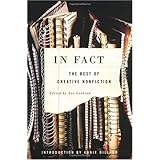
In Fact: The Best of Creative Nonfiction Review

In Fact: The Best of Creative Nonfiction
Average Reviews:

(More customer reviews)
This anthology of selections from the landmark literary journal Creative Nonfiction delivers real-life drama in many voices. Among the authors are well-known writers Andrei Codrescu, John McPhee, Ntozake Shange, Charles Simic, Ruthann Robson, Terry Tempest Williams, Philip Lopate, Madison Smartt Bell, Richard Rodriguez -- and some the editor calls "brilliant newcomers." (I read that and said, "Yeah, right." He was right.) Each essay differs completely from the others, and each in its own way is exquisite -- both pleasurably and painfully so! No monotonous "victim narratives" here. That era was a necessary phase -- and you can identify its traces in this book -- but it's passed. There's suspense, information, humor, reportage, defiance, reflection. Read (in an essay by a reporter for the Philadelphia Inquirer) about a South Philadelphia meth addict who finds 1.2 million dollars in the street. What's he going to do with it? Or a lawyer undergoing grueling cancer treatments who discovers that her doctors have made a terrible miscalculation. Or a Jewish woman enduring the traditional Hebrew divorce ceremony in front of three rabbis and two "shlubs". Or visit with Joe, everybody's blowhard father-in-law supreme. Highly recommended reading for fans, writers, and would-be writers of creative nonfiction. Could be used as a text for teaching a course in contemporary creative nonfiction, just to show how far the genre can stretch, how it can move you, and in general what the genre can do. (Whether or not you like the editor, or Annie Dillard and her foreword -- is irrelevant.)

Click Here to see more reviews about: In Fact: The Best of Creative Nonfiction


Twenty-five arresting selections from thegroundbreaking journal that defined a genre.
Creative nonfiction, also known as narrative nonfiction, liberated journalism by inviting writers to dramatize, interpret, speculate, and even re-create their subjects. Lee Gutkind collects twenty-five essays that flourished on this new ground, all originally published in the journal he founded, Creative Nonfiction, now celebrating its tenth anniversary. Lauren Slater is a therapist in the institution where she was once a patient. John Edgar Wideman reacts passionately to the unjust murder of Emmett Till. Charles Simic tells of wild nights with Uncle Boris. John McPhee creates a rare, personal, album quilt. Terry Tempest Williams speaks on the decline of the prairie dog. Madison Smartt Bell invades Haiti. Many of the writers are crossing genres-from poetry and fiction to nonfiction-symbolic of Creative Nonfiction's scope and popularity. A cross section of the famous and those bound to become so, this collection is a riveting experience highlighting the expanding importance of this dramatic and exciting new genre.

Buy Now

Click here for more information about In Fact: The Best of Creative Nonfiction

Read More...

Discovering Popular Culture (A Longman Topics Reader) Review

Discovering Popular Culture (A Longman Topics Reader)
Average Reviews:

(More customer reviews)
This book was very interesting and really explains the diverse aspects of popular culture. It is easy to understand and the topics of each passage are engaging. Overall the book was enjoyable and is great to use as a reference to papers on popular culture.

Click Here to see more reviews about: Discovering Popular Culture (A Longman Topics Reader)

International Views presents international perceptions of the U.S.'s relationship to the world, as well as views of that relationship from inside the United States, offering opportunities for students to examine the lines of political, ideological, and cultural conflict that can both enrich our international experience and threaten our understanding of America's place in the world.

Buy Now

Click here for more information about Discovering Popular Culture (A Longman Topics Reader)

Read More...

English Sentence Structure (Intensive Course in English Series) Review

English Sentence Structure (Intensive Course in English Series)
Average Reviews:

(More customer reviews)
Eureka! I found the best English grammar book at last. The author successfully dissected and analyzed even the most confusing sentece structure.I have read and studied a lot of books to give me confidence in speaking English as my second language and none of them satisfied me like this book.I recommend it to everyone ! I am grateful for Mr. R. Krohn for sharing his knowledge.

Click Here to see more reviews about: English Sentence Structure (Intensive Course in English Series)

Part of the classic Michigan Rainbow series.English Sentence Structure presents and clarifies all facets of the sentence for beginning and intermediate students. Oral drills, examples, and written exercises form a pattern of regular review and self-evaluation. Each lesson is coordinated with English Pattern Practices.

Buy Now

Click here for more information about English Sentence Structure (Intensive Course in English Series)

Read More...

The Nuts and Bolts of College Writing Review

The Nuts and Bolts of College Writing
Average Reviews:

(More customer reviews)
I first encountered "Nuts and Bolts" several years ago, when it was just a web-site. Back then, Yahoo! gave it one of their "cool sites" awards (complete with cute little sunglasses.) It became such a hit on the web, Hackett decided to give Professor Harvey a publishing contract.
Its great that they did, because the other college writing handbooks are either deadly dull or sprouting whiskers. Nuts and Bolts is neither dry nor bewhiskered -- it is hip, handy, and highly literate. This new book could (and should) evict Strunk and White, Turabian, Chicago Style Book, and all the other has-beens and never-weres as the one book every college student (yes, including science majors) should carry in their book bag. (Dissertation-writers may still need Chicago for their fine brush-work, but everyone else will find this jack-of-all-topics addresses most high-school and college needs.)
What's so great about this book? Essentially, it provides one-stop shopping for the essentials of good college term-paper writing -- usually dispensed in travel-sized doses of only three or four pages.
Nuts and Bolts presumes little, but teaches much. It rides no high horses, grinds no axes, curries no favors. Yet it is both idiot- and pedant -proof. Never written an essay before, but want to know what one is? Nuts and Bolts will tell you, without making you feel stupid for having asked. (Enlightening but non-overwhelming flashback to Montaigne included). Want to know what good sentences look like? (hint: active verbs) How to cite a "blog" in an essay? (take that, Strunk and White!) "Nuts and Bolts" does all this and (much) more while always remembering that brevity is the soul of pedagogy.
Finally, though it crisply marches student essays from the first head-scratch to the last push of the "print" button, its elegant writing and efficient layout make Nuts and Bolts ideal for sustained soaks or surgical strikes as needs dictate. Perfect example: Nuts and Bolts provides side-by-side comparisons of how each of the three major citation-systems expect students to format books, articles, websites (etc.) in their bibliographies and footnotes. A veritable god-send for the student triple-majoring in English Lit, Psychology, and Bio!
This book is written so clearly, and presumes so little background on the part of its reader (Professor Harvey has obviously studied the average scantily-trained college student in its native habitat) that you almost don't realize how supremely intelligent it is. Though it will probably mostly be assigned for remedial purposes, the book is so engagingly written it will inspire even very good writers -- teachers and professors included -- to carry it around in their own soft-sider brief cases. Adios, Strunk and White. Hello, Nuts and Bolts.

Click Here to see more reviews about: The Nuts and Bolts of College Writing

Engagingly written and illustrated with scores of telling examples, this plainspoken how-to book for college writers identifies those qualities that most typically distinguish good writing from bad and provides practical measures for avoiding pitfalls. Included are do's and don'ts for achieving concision, clarity, and flow, as well as pointers on using punctuation, writing gracefully, citing sources, and structuring persuasive writing. Championing "the plain style" with a keen appreciation for the uses to which language can be put—including abuses to which it is prone—The Nuts and Bolts of College Writing is a guide that never fails to remind readers why good writing matters so much in the first place, in college and beyond.

Buy Now

Click here for more information about The Nuts and Bolts of College Writing

Read More...

Handwriting Analysis: The Complete Basic Book Review

Handwriting Analysis: The Complete Basic Book
Average Reviews:

(More customer reviews)
As a professional handwriting analyst for over twenty years I have amassed over six-hundred books and monographs on graphology. Let me say, if the house were burning down this is the one book I'd want to save. There are plenty of good books on handwriting analysis but this still stand the test of time as simply the best. This book is a must have for every handwriting analyst tryo to pro. 5-Stars all the way!

Click Here to see more reviews about: Handwriting Analysis: The Complete Basic Book

Here is a fresh new approach to Handwriting Analysis to help you develop a view of the whole person, not just a piecemeal understanding. It offers exciting features not found in conventional books on Graphology:( An unusually large number of actual size handwriting samples, many of famous people. ( Explanatory material with the samples not in another part of the book. ( New material about determining emotional disturbance and mental illness. ( New ideas on analyzing strokes and shapes. ( New material on understanding the meaning of the writing rhythm. ( Handwriting of children and adolescents. ( Comprehensive, easy-to-use Index.This book will tell you--in clear, precise terms--exactly how to analyze and interpret the handwriting of those you deal with every day: teachers, bosses, children, employees, spouses, parents, lovers, friends ... and your own handwriting as well.

Buy Now

Click here for more information about Handwriting Analysis: The Complete Basic Book

Read More...

Literature and the Writing Process (9th Edition) Review

Literature and the Writing Process (9th Edition)
Average Reviews:

(More customer reviews)
I chose to use McMahan's text because it saves me time as an instructor of English. Composition comprises the most significant portion of a student's grade in a college literature class, and this text teaches students how to write an essay about literature from the beginning of the process to the end. I also like the bonus of a novella, The Awakening, which is often taught at the intro. level but under separate cover. Such a deal.

Click Here to see more reviews about: Literature and the Writing Process (9th Edition)

Literature and the Writing Process combines the best elements of a literature anthologywith those of a handbook to guide students through the interrelated process of analytical reading and critical writing. Text writing assignments use literature as a tool of critical thought, a method for analysis, and a way of communicating ideas. This approach emphasizes writing as the focus of the book with literature as the means to write effectively. A three part organization combines a literary anthologywith composition instructionand a style handbook so students have everything they need at their fingertips.Some of the new features include:New Humor and Satire Portfolios now appear in every genre chapter, offering engaging new readings to encourage student interest.

Buy Now

Click here for more information about Literature and the Writing Process (9th Edition)

Read More...

Constructing Meaning Through Kid-Friendly Comprehension Strategy Instruction Review

Constructing Meaning Through Kid-Friendly Comprehension Strategy Instruction
Average Reviews:

(More customer reviews)
This book is full of practical and kid friendly comprehension strategies that any teacher can use to help students with comprehension. There are charts/posters, sample lessons, and reading activity forms that can be reproduced or forms may be downloaded by a CD that is included with the book. The reading strategy activity forms can be used with a book of your choice to teach a specific reading comprehension strategy. Dr. Nancy Boyles also recommended a bibliography of books to teach each strategy. This is a great book to read if you are still searching for reading strategies to help your class with comprehension.

Click Here to see more reviews about: Constructing Meaning Through Kid-Friendly Comprehension Strategy Instruction

Good readers think about reading whilethey are reading. But how does a teacher teach students to apply comprehension strategies as they read?By applying the explicit teaching model to comprehension strategy instruction, Dr. Nancy Boyles offers teachers an easy, effective, and innovative approach to improve students' reading comprehension. Using her book--rich with models, teacher-talk,and real-life examples--teachers learn how to explicitly teach students to apply comprehension strategies competently while they read. And with Dr. Boyles' detailed lesson plans and templates, teachers can embed comprehension strategy instruction into guided, shared, and independent reading for both literacy and content-area instruction.Constructing Meaning shows teachers:* A kid-friendly way to introduce and model a blended repertoire of comprehension strategies concurrently, so students practice strategies as readers actually use them: flexibly and as an integrated whole while reading.* How to refine students' comprehension of fiction and informational text during shared, guided, and independent reading with focused lessons in specific strategy applications.* How to monitor students' progress in reading comprehension and comprehension strategy use through follow-up activities, rubrics with discrete assessment criteria, and questions that make kids think.Teachers can reproduce classroom-ready visual supports from the book or customize them from the included CD.

Buy Now

Click here for more information about Constructing Meaning Through Kid-Friendly Comprehension Strategy Instruction

Read More...

The Middle School Writing Toolkit Review

The Middle School Writing Toolkit
Average Reviews:

(More customer reviews)
If you are a middle school teacher, this book is a must-have! I'm a fairly new teacher and this book has given me enough material to run my writer's workshop for months. There are tons of lessons and assignments here that you can use the day you get the book. The lessons are very straightforward and easy to use. Each writing strand has its own chapter and set of lessons that help you teach any of the major writing genres, including persuasive, literary essay, narratives, how to, and reports.
My school is moving toward differentiated instruction in writing, so this book is a blessing. Each lesson has four writing tasks associated with it, from easy to challenging ones. Not only that, but this book takes you step by step through the process of teaching a differentiated lesson to a heterogeneously grouped class. I think this alone is priceless!
There are tasks, rubrics, charts--everything you'd want in a book about middle school writing.
Highly recommended!

Click Here to see more reviews about: The Middle School Writing Toolkit


Designed specifically for all middle-school teachers, The Middle School Writing Toolkit has everything needed to get your writer's workshop up and running whether you're a language arts teacher looking for new writing workshop ideas or a subject-area teacher who wants to improve the quality of student papers.
The Middle School Writing Toolkit addresses the five major writing genres that middle-school students are expected to master reports, persuasive essays, how-to (procedural) essays, narratives, and literary responses and provides mini-lessons and tasks to start English teachers well on their way to creating a successful writing program in the classroom.
Teachers in other subjects will find plenty of writing tasks on research, informational reports, biographies, and more to work into their daily curriculum, allowing for both subject exploration and writing mastery.
Fifty-seven writing mini-lessons and more than 200 differentiated workstation tasks, as well as time-saving forms, charts, and rubrics, make this a complete and useful resource for any middle-school classroom.
With The Middle School Writing Toolkit, you can transform your classroom into a successful writer's workshop and students of all abilities can master writing in any genre.
NEW! The Middle School Writing Toolkit is a finalist for the 2008 Next Generation Indie Book Awards!


Buy Now

Click here for more information about The Middle School Writing Toolkit

Read More...

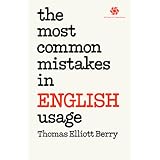
The Most Common Mistakes in English Usage (Schaum's Paperbacks) Review

The Most Common Mistakes in English Usage (Schaum's Paperbacks)
Average Reviews:

(More customer reviews)
I've owned this book for about ten years and moved it with me whenever I get a new technical writing assignment. It has saved my writing hide with the subject matter experts numerous times! It shows the most common errors made in English usage in an easy-to-understand manner. I had trouble with misplaced modifiers and "like" as opposed to "such as" for years. This book helped me learn which way is correct usage!
I like the straighforward and often humorous style. I'd love to see future editions.

Click Here to see more reviews about: The Most Common Mistakes in English Usage (Schaum's Paperbacks)


This book analyzes the errors most commonly made in spoken and written English and presents them in a systematic, down-to-earth manner. It does not dictate grammar to the reader; rather, it presents the guidelines for English usage currently being observed by the most competent and careful speakers and writers.


Buy Now

Click here for more information about The Most Common Mistakes in English Usage (Schaum's Paperbacks)

Read More...

English Composition and Grammar : Complete Course Review

English Composition and Grammar : Complete Course
Average Reviews:

(More customer reviews)
I learned to refine my writing using this book back in high school, and I still return to it often. It is very thorough and contains indispensable exercises, which allow the reader to practice each lessson. The book starts out with parts of speech and diagramming sentences, continues on through style and punctuation issues, and finishes with discussions and examples of research papers, business letters, tests of english, and public speaking. This book is perfect for any diligent student of writing in English, no matter what level of competence.

Click Here to see more reviews about: English Composition and Grammar : Complete Course


Buy Now

Click here for more information about English Composition and Grammar : Complete Course

Read More...

Writing Road to Reading 5th Rev Ed: The Spalding Method for Teaching Speech, Spelling, Writing, and Reading (Harperresource Book) Review

Writing Road to Reading 5th Rev Ed: The Spalding Method for Teaching Speech, Spelling, Writing, and Reading (Harperresource Book)
Average Reviews:

(More customer reviews)
When I first heard about this system, I kept hearing and reading that "flashcards are in the book". NOT in this 5th edition.
They are in the EARLIER editions (little 3 1/2" squares that you can either cut out and laminate or make copies and paste onto 3x5 index cards if you don't want to ruin the book). The info on the cards is in the book, but not in the flashcard format--they hope that you will buy a set from them.
Also missing from this 5th edition but present in earlier editions (via one of those floppy 33 1/3 speed records) is a recording of the phonograms--why they didn't include a CD with this new edition and raise the price a tad is beyond me. You have to go to their site to buy a recording.
As to whether the 5th edition is an improvement over the previous editions, I have mixed feelings. Yes, there is more "teaching info", such as the dialogues the teacher should use (which you may not bother with if you homeschool), but in some ways it makes it more difficult to actually get to the lessons per se. The word list is extended. It still uses their "clock method" of teaching handwriting, which makes for that very round, old-fashioned "school" look. Many schools now teach D'Nealian, which supposedly is easier to transition to cursive handwriting later (imho, they should teach Italic calligraphy instead). It still has samples of the notebook pages, but in a different part of the book than where the teaching dialogues are (again, they assume that this book/system is being used in a classroom, and you have the laminated posters, as well as laminated flashcards for everyone). The earlier editions have the full-size sample pages right next to the actual lesson.
I actually felt it necessary, after buying the 5th edition AND after borrowing an earlier edition from my library, to buy one of the earlier editions (4th) used on Amazon in order to get the flashcards and the recording, as well as to more easily understand the lessons, because in the earlier editions the information is more or less presented and you move on, as opposed to being discussed at length as it is in the 5th edition.
Also, I was disappointed that the 5th edition, unlike previous editions, is printed on newsprint (it resembles a smaller phonebook both in heft and feel when you turn the pages) and not on better quality paper--I'm skeptical as to how long it will last over time, and with what is essentially a reference textbook, you want something that will last for more than one child.
Bottom line: the system is great. However, this 5th edition seems to really be written for classroom teaching--I feel that for homeschooling parents and someone learning on his own, that they would be well-advised to get an earlier edition (4th or 3rd) with the floppy record if you have access to a record player. The 5th does have an extended "parts of speech" writing portion, that the earlier editions don't have, but there are more interesting grammar books out there, for example, some of Karen Gordon's books.

Click Here to see more reviews about: Writing Road to Reading 5th Rev Ed: The Spalding Method for Teaching Speech, Spelling, Writing, and Reading (Harperresource Book)


The Spalding Method is a total language arts approach that has been used by teachers and parents for nearly fifty years to teach millions of students to spell, write, and read. Now fully updated to reflect the latest research on how children learn language, this newest edition is easier to use than ever.

The Spalding Method helps train the right and left sides of the brain as children see, hear, read, and write. It is cost-effective and efficient; students use pencils, paper, and their minds. The results are stunning: Children learn to connect speech sounds to print and begin to write and read almost magically. Spalding students perform well in the classroom and on tests -- and most important, they love to read and write.


Buy Now

Click here for more information about Writing Road to Reading 5th Rev Ed: The Spalding Method for Teaching Speech, Spelling, Writing, and Reading (Harperresource Book)

Read More...

Giggles in the Middle: Caught'ya Grammar with a Giggle for Middle School (Caught'ya Grammar with a Giggle) (Caught'ya Grammar with a Giggle) Review

Giggles in the Middle: Caught'ya Grammar with a Giggle for Middle School (Caught'ya Grammar with a Giggle) (Caught'ya Grammar with a Giggle)
Average Reviews:

(More customer reviews)
I am "testing" this out with my class of gifted fourth-graders, and they love it! They enjoy getting to know a little bit more each day about the kids at Horribly Hard Middle School as well as dream about going to Magic Middle School. What surprised me most was the vocabulary piece. The words are well chosen and well placed. Often I find "challenging" vocabulary to just be wacky- words that we don't hear in our everyday lives. This book, however, keeps the students' interest regarding strong, usable vocabulary. They WANT to look the words up in the dictionary so they have a better understanding of the story, the puns involved, or just to be the one to get to read from the dictionary. We are only on day 16 of the program and I can already see results in the students' own writing.
Teacher's Request to Publisher: Please print a version of this in a binder or spiral format! The little paperback book is a bit hard to hold for reference while writing on the board and teaching the kids (but worth it!). I would pay for it again! :)

Click Here to see more reviews about: Giggles in the Middle: Caught'ya Grammar with a Giggle for Middle School (Caught'ya Grammar with a Giggle) (Caught'ya Grammar with a Giggle)

Jane Bell Kiester, author of the popular Caught'ya! Grammar with a Giggle series, has adapted her effective and fun approach to meet the specific learning needs of middle-school students.
Giggles in the Middle gives middle-school teachers the perfect alternative to boring grammar books and dry lectures. With this flexible, proven approach to teaching grammar, usage, and mechanics (GUM) skills and vocabulary, everyone has fun while they learn skills in context.
You'll find: - One continuous story, "The Bizarre Mystery of Horribly Hard Middle School," divided into three parts, each with enough sentences for an entire school year. - Classroom-tested writing assignment suggestions, mini-lessons, and teaching tips. - "Almost midterm" and final exam tests for each grade, with teacher keys. - Easy-to-follow, step-by-step instructions. - Complete vocabulary lists for words used in each part of the story. - For easy reference and duplication, a CD with the Grammar, Usage, and Mechanics Guide; the complete, uninterrupted story in narrative form; the midterm and final exam tests; and the Caught'ya sentences.
Use Giggles in the Middle to improve writing and editing skills, raise test scores, engage students in leaning, and create classrooms filled with giggles!

Buy Now

Click here for more information about Giggles in the Middle: Caught'ya Grammar with a Giggle for Middle School (Caught'ya Grammar with a Giggle) (Caught'ya Grammar with a Giggle)

Read More...

Evergreen: A Guide to Writing with Readings Review

Evergreen: A Guide to Writing with Readings
Average Reviews:

(More customer reviews)
We use Susan Fawcett's book 'Evergreen' in writing courses at the community college where I work, as well as in our Tutoring Center (we also use her book 'Grassroots', which is a good companion at the more basic level). Whereas 'Grassroots' is for those who need help writing sentences and with more basic grammar concepts, the 'Evergreen' book is for those who have mastered that level of writing, and are ready to develop more fully structured themes and essays.
The first unit of 'Evergreen' reviews the basic concepts of the writing process - what is one writing for? Who is the likely or intended audience? How should a finished paper look? Believe it or not, it is on this last point that so many grades have risen or fallen - a paper can be wonderfully written, but if it is scribbled on scrap paper rather than typewritten and neatly printed, it may suffer in grading, just as a letter from a business will not be as well received if it has spelling errors and problems with formatting. (This is a similar introduction to the 'Grassroots' text.)
The second unit looks for explicitly at the paragraph, developing concepts such as coherence, topic sentences, ideas to include and exclude, as well as outlining and revising.
The third and fourth units in this book are really the heart of the writing process. In the development of the paragraph, there are different approaches and techniques one can take - the paragraph can be descriptive, narrative, explanatory of a definition, comparison and contrast, persuasive, and a few other means. These lead naturally into the development of the essay, which is generally a series of paragraphs that are linked by a common idea or theme - some of the same processes that go into the development of a paragraph parallel the development of an essay, and many of the same descriptors above apply to paragraph forms, too. The fifth unit extends this kind of essay development by exploring sentence variety, language awareness and consistency in the revision process.
Units 6 and 7 are review chapters for grammar concepts, punctuation, and spelling. These are really review areas - they do not go into enough depth or repetition for this to be an introductory text, but rather will assume some familiarity with the concepts being presented.
The final section has a collection of reading selections, some from well-known authors and other figures. There are pieces that provide examples for the different kinds of essays described earlier in the book - some pieces are narrative, some are persuasive, some are humourous.
This is a good book to use to become a better writer. It is useful in classroom settings, but might also be used for individual study (such as we do in the Tutoring Center).


Click Here to see more reviews about: Evergreen: A Guide to Writing with Readings

Evergreen combines carefully crafted instruction, high-interest readings and student models, and plentiful practice exercises, to provide the most effective paragraph-to-essay-level developmental writing text on the market. The ninth edition includes expanded and revised coverage of writing essays, including an additional essay chapter and numerous additional student models. Photos enhance high-interest readings and promote critical viewing as well as critical thinking and clear writing.

Buy Now

Click here for more information about Evergreen: A Guide to Writing with Readings

Read More...

College Writing Skills w/ Readings Review

College Writing Skills w/ Readings
Average Reviews:

(More customer reviews)
THis book is being used by my daughter in college. It is well written and a book that can be used as a reference for the rest of her college time.

Click Here to see more reviews about: College Writing Skills w/ Readings

John Langan's College Writing Skills with Readings, Seventh Edition, focuses on the essay using Langan's renowned clear writing style, as well as his wide range of writing assignments and activities that reinforce the four bases of effective writing: unity, support, coherence, and sentence skills.For the new seventh edition, John Langan has added a variety of fresh elements to his proven approach.

Buy Now

Click here for more information about College Writing Skills w/ Readings

Read More...